Ordinary Agency · Landowner proposal
Turn your static billboard into a digital asset.
We fund the conversion. We manage the approvals. We carry the delivery risk. You contribute the site and nothing else, and there is a hard 18-month cap on how long capital recovery can run before your share starts.
The opportunity
A static face earns one rate from one advertiser. A digital face earns from ten at once, and earns more in total.
A static billboard is a fixed asset on a fixed return. One advertiser, one message, one rate, for as long as the vinyl stays up. Changing it means booking a crew.
A digital face carries ten advertisers on rotation. Each buys a share of the screen rather than the whole thing, so no single advertiser pays static rates. The site earns more in total because digital sells at a premium per impression, campaigns can run for a fortnight instead of a quarter, and rates move with demand instead of sitting flat for a year.
The barrier has always been capital. A digital conversion costs $150,000 to $250,000, plus an approvals process most landowners have neither the time nor the appetite to navigate.
We remove both. We fund the entire conversion, manage both approval processes, and carry all of the delivery risk.
One message. One rate. Changed only by a site visit.
Fixed annual returnTen advertisers on rotation. Eight commercial, two held for community and charity.
Higher total yield, and it moves with demandThe first screen in a sightline
Why the first screen in a viewshed matters.
Main Roads will not approve a digital sign over 6 m² where it is visible from the same vantage point as an existing digital sign over 6 m².
That rule cuts one way. Whoever converts first in a sightline effectively closes it. Every subsequent large-format digital application in the same viewshed fails on that ground alone, regardless of how good the competing site is.
If a nearby site converts before yours, your billboard stays static for the life of that approval. If yours converts first, it is the only large digital face in that line of sight.
We check this before we commit to a site, and we will tell you what we find either way.
The proposition
Six steps, and no landowner capital in any of them.
- We assess your billboard against Main Roads and local planning criteria before either party commits.
- We fund and lodge the development application at our cost.
- Subject to approval, we fund and manage the full digital build.
- Advertising revenue first repays our build capital. Typically 12 to 18 months, and capped at 18 by the longstop.
- From that point, revenue is split 50/50 with you for the balance of a 10-year lease.
- Revenue is reconciled and paid to you quarterly, with a full performance and account report each quarter.
Case study
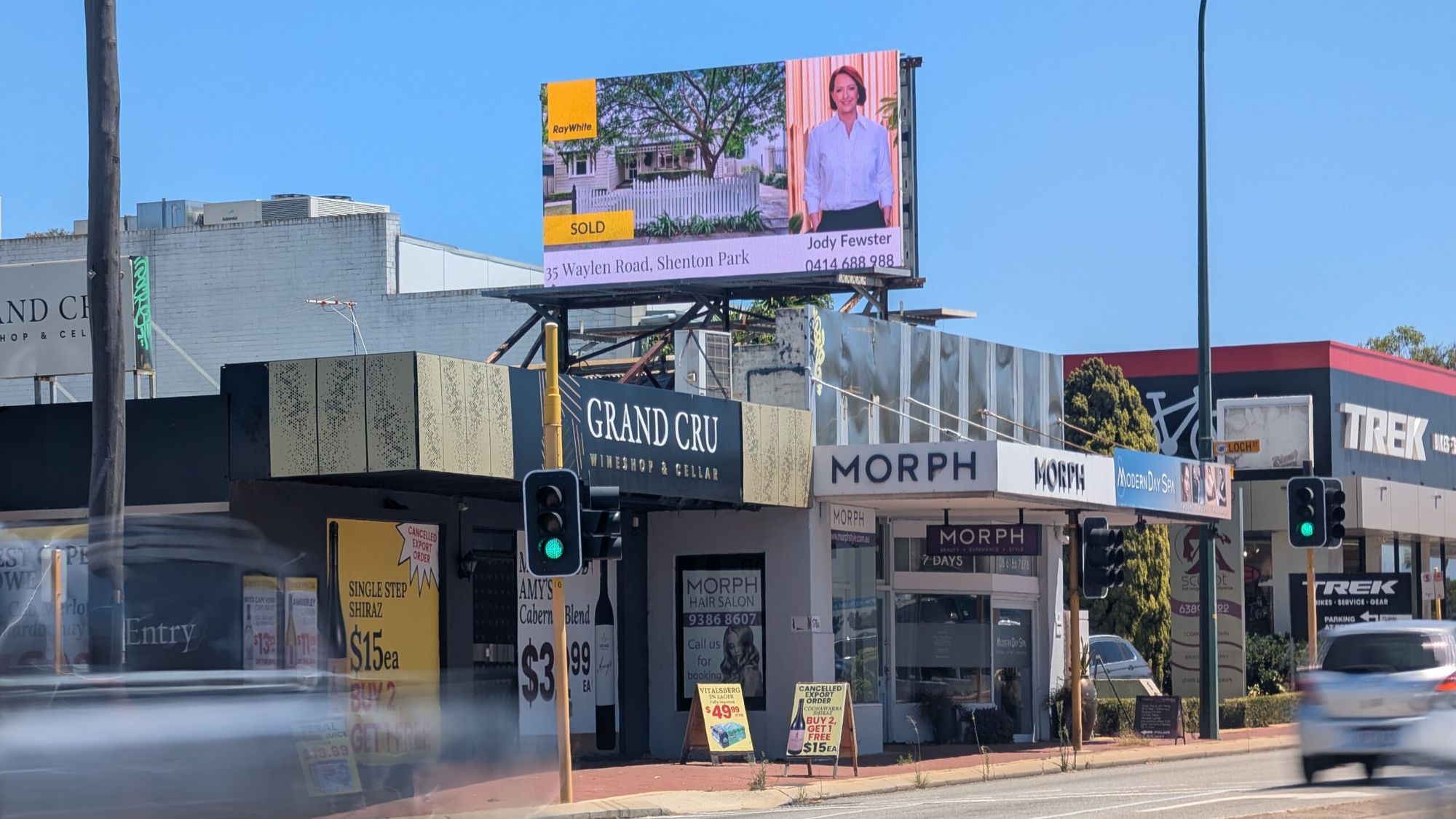
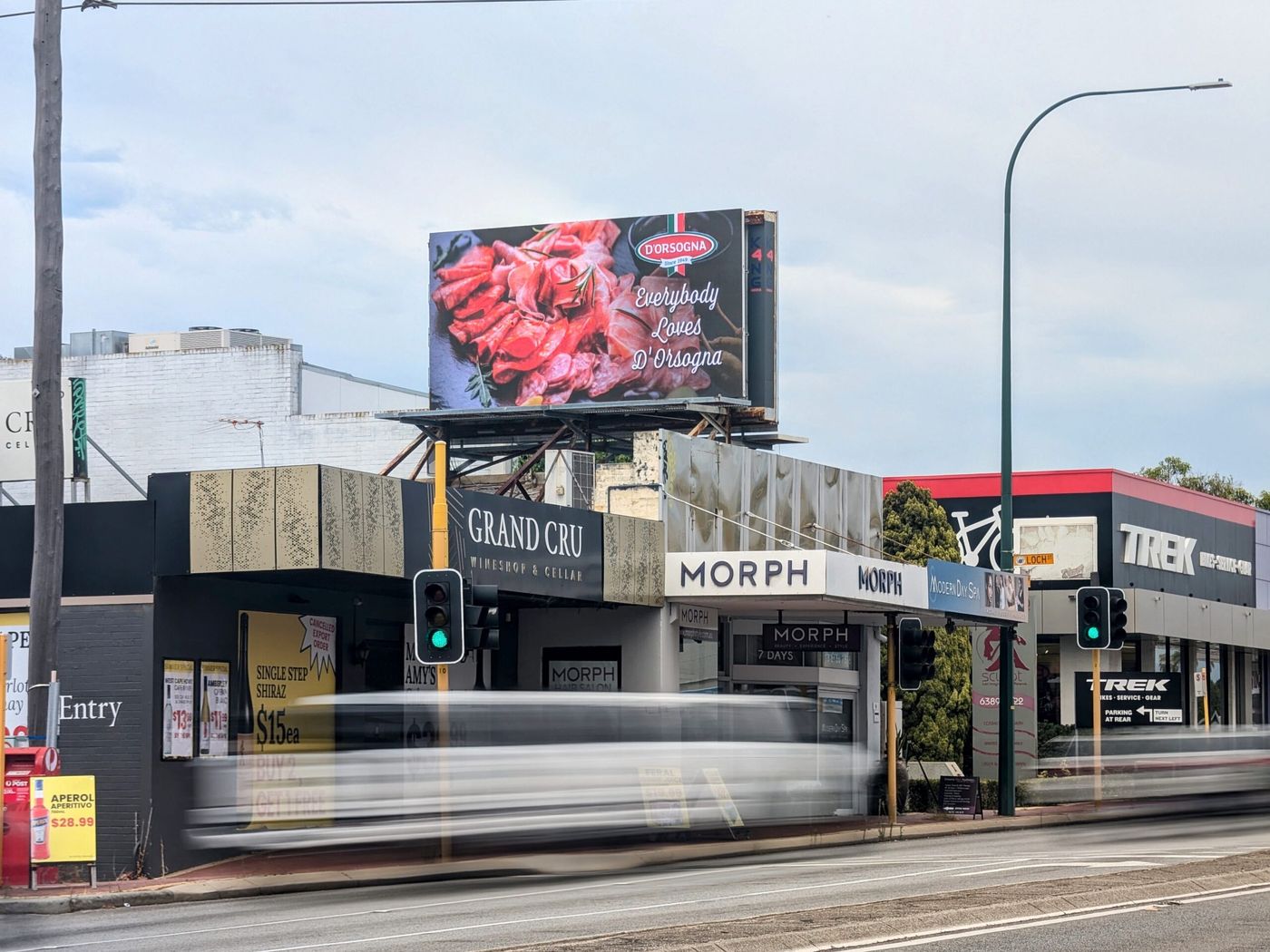
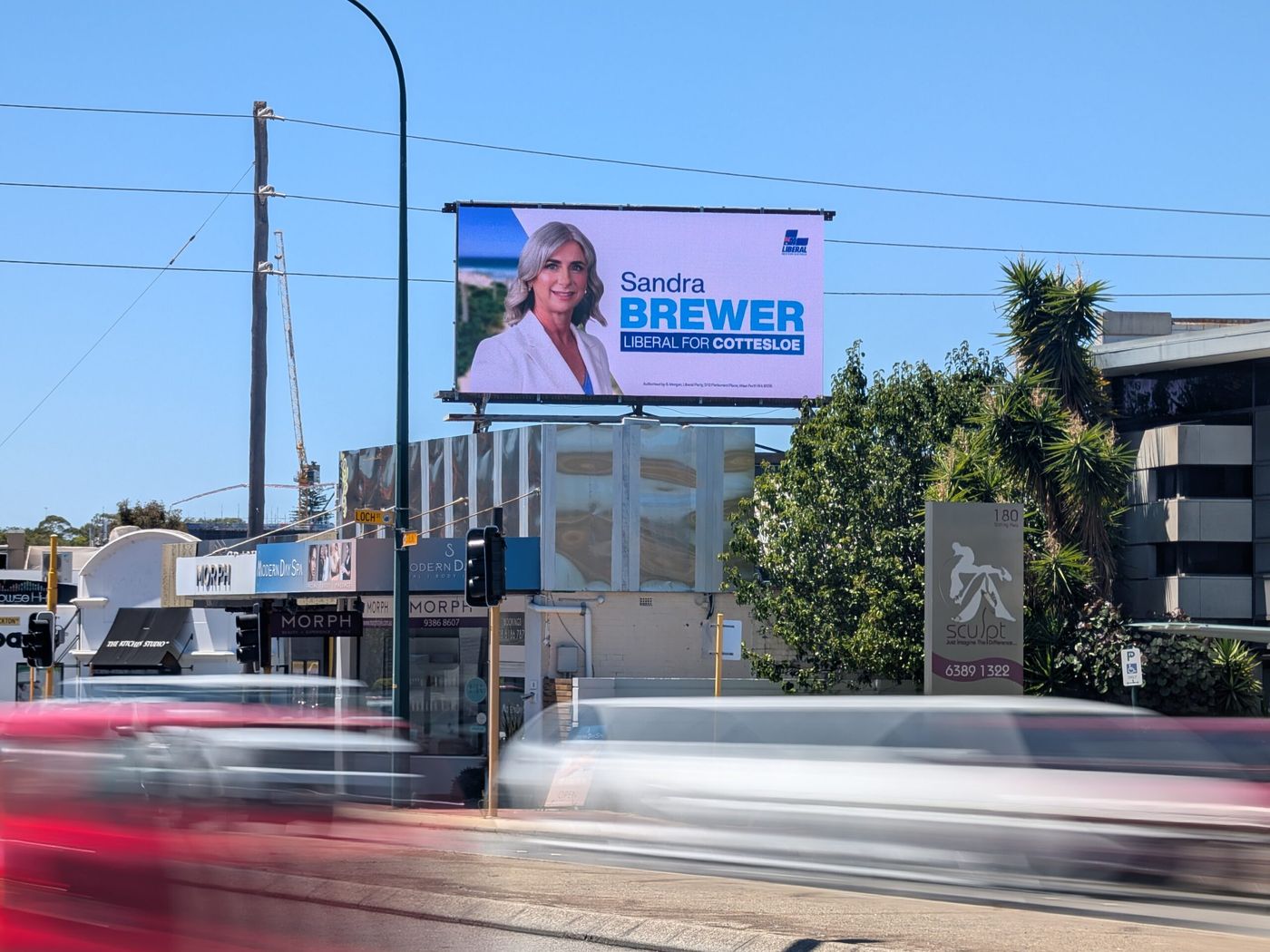
178A Stirling Highway, Nedlands
A double-sided site we managed for 26 months — including a static-to-digital conversion we delivered ourselves.
The site
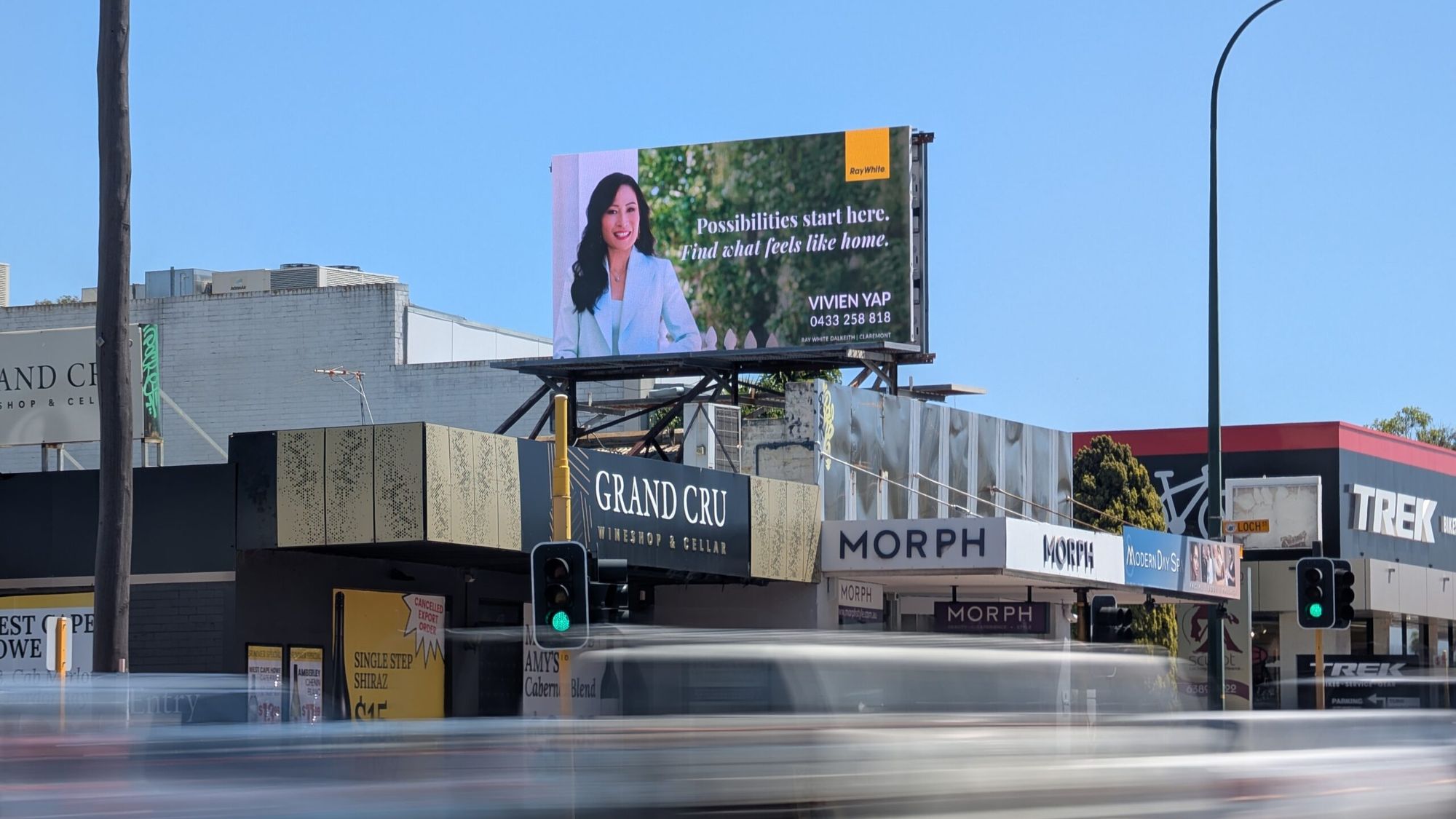
A double-sided billboard on Stirling Highway, in one of Perth's highest-value western-suburbs corridors — traffic running toward Dalkeith, Nedlands, Peppermint Grove and Claremont.
- East-facing screen — already digital when we took over management in December 2023
- West-facing screen — a static billboard, which we converted to digital in January 2025
What we delivered
- Took over advertising management of the site in December 2023
- Coordinated the full west-screen conversion end to end, managing the installation contractor
- Filled and maintained a 10-slot rotation on each screen — eight commercial, two reserved for community and charity content
- Held signed contracts with premium local advertisers across property, real estate and professional services
- Engaged two media sales agencies to maintain a forward booking pipeline
- Built and ran the site's own advertiser page — stirlinghwybillboard.com.au — carrying the location, the rate card and a booking enquiry form. It is still live
- Issued monthly performance reporting, a full transaction account summary and a tax invoice, every month for 26 months
The converted west screen went live on 7 February 2025 — with paying advertisers from day one. No ramp-up, no vacant inventory, no lag between capital spend and revenue.
How we fill the screen
The screen only earns if the slots are sold.
Exactly how we do it — six channels, running at once, from the day the screen goes live.
Existing agency relationships
Ordinary Agency already runs digital campaigns for local businesses — the first place a new screen gets sold.
Media sales partnerships
Working relationships with outdoor media agencies carrying their own advertiser books.
The screen sells itself
Unsold slots run our own 'advertise here' creative — reaching exactly who's driving past.
A dedicated site page
Location, traffic data, rate card and a booking enquiry form for inbound interest — as we built at stirlinghwybillboard.com.au.
Direct local outreach
We approach the advertisers who pay best — usually within a few kilometres of the site.
Community & charity slots
Reserved inventory that builds goodwill and steady commercial enquiry.
The roster we built — 10 slots per screen
Property and real estate, 6 slots. Professional services, 2 slots. Community and charity, 2 slots.
How the deal works
Two phases. No landowner capital at any point.
First 12–18 months
Phase 1 — Capital recovery
All revenue, after direct operating costs, repays the build capital until it is recovered in full.
Remainder of the term
Phase 2 — 10-year revenue share
Once capital is repaid, revenue splits 50/50 with you for the remainder of the 10-year term, reconciled and paid quarterly.
Phase 1 — Capital recovery
- All advertising revenue, after direct operating costs, repays the build capital until it is recovered in full
- On rates comparable to the sites we have run, a fully tenanted screen supports recovery inside 18 months
- The recoverable capital is a fixed dollar figure stated in the agreement, so you know from day one exactly what has to be repaid
- An 18-month longstop applies. If capital is not fully recovered by month 18, the 50/50 split begins anyway, and any shortfall carries against our share alone
Phase 2 — Revenue share
- Once capital is repaid, revenue splits 50/50 with you for the remainder of the 10-year term, reconciled and paid quarterly
Why an equal split? The risk is not equal, and it is not carried by you — we fund the application, absorb the loss if it is refused, fund the build, and wear the payback period before we see a dollar of profit. You contribute the site and carry nothing.
What comes off the top
Every deduction, itemised.
Advertising revenue is a gross figure. Direct operating costs are deducted before any split, in both phases — each a third-party invoiced cost we can evidence on request.
| Operating cost | Per quarter | Notes |
|---|---|---|
| Power | $400 – $900 | 200–600 W/m² at full brightness; overnight auto-dim cuts draw to roughly 30% |
| Insurance | $600 – $1,250 | Property, public liability and loss of income |
| Servicing & cleaning | $300 – $800 | Annual inspection and face wash, annualised across the year |
| Data / connectivity | $120 | Screen uplink for remote content delivery |
| CMS licence | $90 | Scheduling and content management platform |
| Reactive repairs | As required | ~$1,100 per after-hours attendance; $350–$900 per module out of warranty |
| Third-party media sales commission | Agreed rate | Where a media agency books a slot, the agency's commission is deducted before the split. Direct sales carry no commission |
| Indicative total | $1,510 – $3,160 | Per quarter, excluding reactive repairs and commission |
Indicative only — we model these precisely for your site, and give you the figures, before anything is signed.
Our management is not a deduction. We take no retainer, management fee or overhead off the top. Our 50% share is our entire compensation for running the site.
The one exception is third-party media sales commission. Where a slot is booked through an outside media agency, that agency's fee is a real third-party cost and comes out before the split, at a rate fixed in the lease. Slots we sell ourselves carry no commission at all, so our incentive is to sell direct.
Why this is a strong deal — and what has to be true
The benefits to you, and the conditions we owe you honesty about.
Why this is a strong deal for a landowner
- Zero capital at risk. We fund the application and the build. If approval is refused, we absorb the loss, not you
- No operational burden. Approvals, construction, advertiser sales, creative management, billing and maintenance are all ours
- A materially better asset. A digital face multiplies the number of advertisers a single structure can carry
- Transparent quarterly reporting. Full performance, account summary and payment every quarter — to the standard we maintained monthly for 26 months on Stirling Highway
- Proven delivery. We have converted a static face to digital and had it earning from its first day of operation
1. Regulatory approval
Two separate approvals are required, and either can stop the project.
- Main Roads WA, where the sign is visible from a state road. They assess the crash risk category of the road and intersections around the site, visibility distance, proximity to traffic signals and merge points, sign area, height, luminance and content dwell time
- The local government, under its planning scheme and signage policy. Some councils restrict or prohibit third-party advertising outright. We check this first, because it makes every other question irrelevant
- Main Roads approval does not oblige a council to approve. The State Administrative Tribunal has upheld a council policy prohibiting third-party advertising even where road safety was satisfied. We do not treat one approval as securing the other, and we will not tell you otherwise
- Approvals are time-limited. Main Roads approvals run to a maximum of 15 years and can be revoked, or ended on six months' written notice where Main Roads needs the land for its own functions. Some councils cap advertising approvals shorter. Our lease is written to sit inside whichever term is shorter, and what happens if an approval ends early is documented before you sign
- Some sites need a landscape and visual assessment, which is a substantial consultant report with photomontages and night-time visualisations. Pole-mounted billboards usually trigger it. We pay for it
- Screen brightness is regulated. Digital signs are assessed against AS/NZS 4282 and must dim through dawn and dusk. On some sites a brightness condition is the deciding factor in whether the screen is commercially viable, and we resolve it before we build, not after
- We carry all of this. If approval is refused, you owe nothing and are not liable for any cost we have incurred
2. Site suitability
- Traffic volume and sightline quality sufficient to command digital rates
- Structural capacity, or a viable rebuild path, for the digital panel and its wind loading
- Practical power supply — some sites require an upgraded connection
- No competing signage restriction attaching to the title or the existing approval
3. Commercial terms
- A 10-year lease is required to justify the capital at risk
- Recoverable capital is a fixed dollar figure, with an 18-month longstop after which the 50/50 split begins regardless
- Direct operating costs deducted are limited to the categories listed above, each evidenced by invoice on request
- Independent road safety audits are required by Main Roads during the term, at our cost, not yours. If an audit results in a change to how the screen operates, we tell you and we explain what it means for revenue
- Revenue reconciled quarterly, with payment and a full account statement after each quarter's end
- Termination rights and protections on a sale of the land are documented in full before anything is signed
- The structure is fully insured — public liability, property and loss of income — for the life of the term
- Asset ownership at end of term is agreed in writing, along with a first opportunity to negotiate any subsequent agreement
Questions you should ask
The answers we would give before you have to ask.
What happens if the application is refused?
You owe nothing. We fund the development application, the traffic and planning work behind it, and any consultant reports required. If Main Roads or the council refuses it, we absorb that cost in full.
Why is the split 50/50 rather than more in my favour?
Because we carry the entire downside — the approvals, the build, and the payback period — before we earn a cent of profit. You contribute the site and take no financial risk at any stage.
Do I receive anything during the payback period?
Revenue in Phase 1 goes to recovering the build capital, so your payments begin once that is done. Typically 12 to 18 months, and no later than month 18 under the longstop. If a minimum quarterly payment from day one matters to you, say so early and we will structure it in.
What if I sell the property?
The lease is documented so it survives a sale and binds a future owner — protecting our capital, and adding a contracted income stream to what you are selling.
How do I know when the capital has actually been repaid?
The recoverable capital is a stated dollar figure in the agreement, not an open-ended total, and each quarterly statement shows the balance outstanding. The 18-month longstop caps how long that can run.
Who owns the screen at the end of the 10 years?
You do. We will be straight about what that is worth: LED screens run roughly 8 to 12 years, so by year 10 the panel will be near end of life. The real value transferring is the structure, the approval, and a proven site.
What happens after the 10 years?
The screen and structure are yours to do with as you like. We would want to fund a new screen and continue — the lease gives us first opportunity to negotiate before you go to market, not a right to match anyone else's offer. If a replacement makes sense earlier, we would fund it in exchange for an extension.
What if you cannot sell the advertising?
Then we do not recover our capital, and the loss is ours. That is why we assess traffic, sightlines and demand before committing — and on Stirling Highway we filled 20 slots across two screens with the converted screen earning from day one.
Will the screen actually be bright enough to work?
It has to be bright enough to read in daylight and dim enough not to be a nuisance at night, and both are regulated. Digital signs are assessed against the Australian standard for outdoor lighting, and screens dim automatically through dawn and dusk. Brightness conditions vary between councils, and on some sites they are the deciding factor in whether a conversion is worth building at all. We settle this with the authorities before we commit capital, and if a site cannot carry a workable brightness condition we will tell you rather than build something neither of us can sell.
Can the approval be taken away?
Main Roads approvals run to a maximum of 15 years and can be ended on six months' written notice where Main Roads needs the site for its own works. It is uncommon, but it is real and we would rather you heard it from us. Our lease sets out what happens to the structure and to your income if that occurs, and the capital exposure sits with us.
Is there anything ongoing I need to deal with?
No. Main Roads requires independent road safety audits during the term, and we commission and pay for them. If an audit results in a change to how the screen runs, we tell you what changed and what it means. You are not asked to do anything.
Could a competitor put a screen up next to mine?
Not a large one, if yours goes up first. Main Roads will not approve a digital sign over 6 m² that is visible from the same vantage point as an existing one. Converting first closes the sightline. It is one of the few genuine reasons to move now rather than in two years.
How do I know the revenue figures are accurate?
Every quarter you receive a performance report, a full transaction summary and your payment — the same standard we produced monthly for 26 months on Stirling Highway, delivered quarterly to keep admin light on both sides.
Do I have any say over what is advertised?
Yes. Category exclusions are agreed in the lease before we start selling, and we reserve slots for community and charity content, as we did on Stirling Highway.
What if the structure damages property or injures someone?
The structure is fully insured for the life of the term — public liability, property and loss of income — and engineered and certified for wind loading, with your interest noted on the policy.
How long does the whole process take?
Approvals are the variable stage and can run several months. Construction is comparatively quick. We give you an indicative timeline for your site before you commit to anything.
Next steps
Four steps, and the first one costs you nothing.
- Site assessment — we review your billboard and give you a straight answer on viability, at no cost.
- Indicative numbers — we model expected advertiser demand, build cost and payback period for your site.
- Heads of agreement — terms documented and agreed before any application is lodged.
- Application and build — we take it from there.
The site does not change. The economics do.
We have already taken a static face on Stirling Highway, converted it, and had it earning from day one. We are looking for the next site to do it on.
The site assessment costs you nothing and we will give you a straight answer either way.
We are looking for the next site. If yours is not right, we would rather tell you in the first conversation than in the fourth.